Your MDCAT aggregate is one number. It decides how your Matric marks, your FSc marks, and your MDCAT score are combined into a single percentage. This guide shows you how to calculate MDCAT aggregate step by step, with the exact formula, worked examples, and the reverse calculation that tells you what MDCAT score you need for the aggregate you want.
The Short Answer: The PMDC Formula
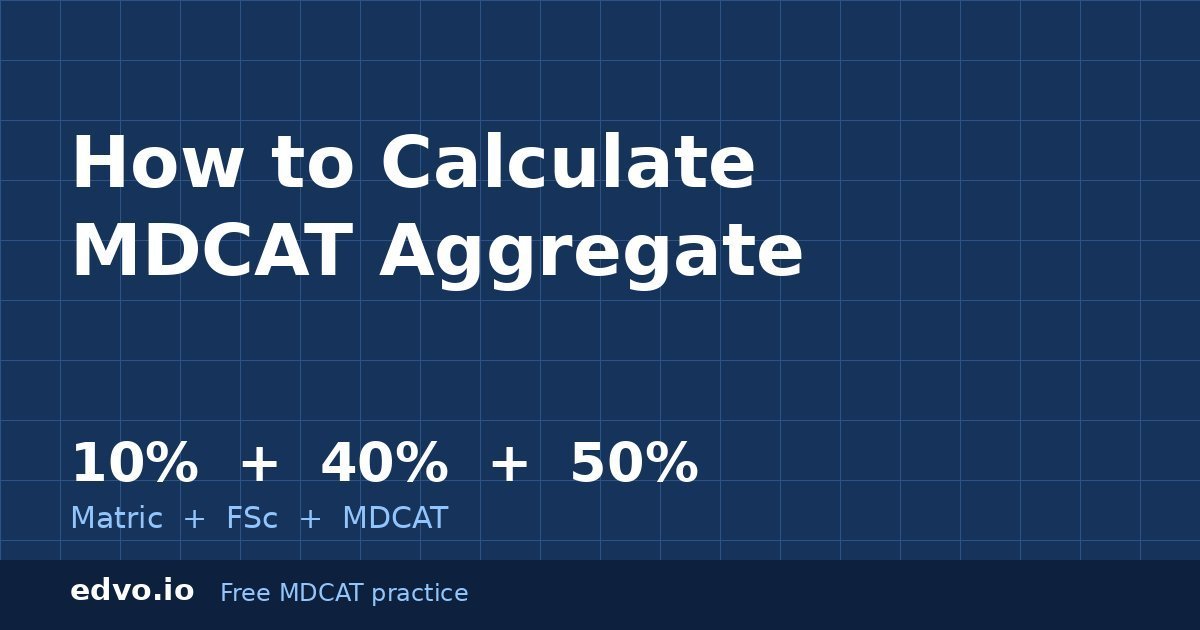
Here is the whole method in one line. The PMDC formula for MDCAT aggregate is: Aggregate = 10% of SSC (Matric) + 40% of FSc + 50% of MDCAT.
Aggregate = 10% of SSC (Matric) + 40% of FSc + 50% of MDCAT.
Three parts, three weights, one total. Matric counts for 10 parts out of 100, FSc for 40, and MDCAT for 50. Half of your aggregate comes from the MDCAT, so it is the single biggest part, but a strong FSc result still moves your total by a large amount.
One point causes confusion, so let us settle it at the start: the three exams are not all out of the same total. Matric and FSc are usually out of 1100 marks; the MDCAT is out of 180. The formula turns each result into a share of its own total first, and only then applies the weight. You never add raw marks together. You convert, you weight, and then you add.
Visual 1: The Formula as a Diagram
The diagram below shows the three parts of the formula and how they join into one aggregate.
What Each Part Means
SSC, 10%. SSC means your Matric result, normally out of 1100 marks. It has the smallest weight. A difference of 100 Matric marks changes your aggregate by less than 1%. Matric still matters, but it cannot rescue a weak MDCAT or ruin a strong one.
FSc, 40%. FSc means your intermediate result, normally out of 1100 marks. This is the second biggest part. A difference of 100 FSc marks changes your aggregate by about 3.6%. That is a real swing. If you are still studying for FSc, take it seriously alongside MDCAT preparation.
MDCAT, 50%. The MDCAT is out of 180 marks. Because it carries half the weight, each MDCAT mark is worth more than each Matric or FSc mark. One MDCAT mark is worth 50 divided by 180, which is about 0.28% of aggregate. Ten MDCAT marks are worth about 2.8%.
Visual 2: How Much Each Part Counts
The donut below shows the same weights as shares of the full aggregate.
The MDCAT half is the biggest slice, FSc is close behind, and Matric is small. Spend the most effort where the weight is biggest.
The Three Steps, Every Time
Every aggregate calculation follows the same three steps. Learn them once, and you can do any example by hand.
- Convert each result to a share of its own total. Divide your obtained marks by the total marks for that exam. For Matric and FSc, the total is normally 1100. For MDCAT, the total is 180.
- Multiply by the weight. Multiply the SSC share by 10, the FSc share by 40, and the MDCAT share by 50.
- Add the three parts. The sum is your aggregate, as a percentage out of 100.
That is the whole method. Now let us use it on real numbers, with every step shown, so you can check your own working against ours.
Worked Example 1: Step by Step
Take a student with these results: SSC 1050 out of 1100, FSc 1020 out of 1100, and MDCAT 165 out of 180. These are strong results, and they make a good first example because every step comes out cleanly.
Step 1, SSC part. Divide 1050 by 1100, then multiply by 10. That is (1050 ÷ 1100) × 10 = 9.545. So Matric adds 9.545 to the aggregate.
Step 2, FSc part. Divide 1020 by 1100, then multiply by 40. That is (1020 ÷ 1100) × 40 = 37.091. So FSc adds 37.091 to the aggregate.
Step 3, MDCAT part. Divide 165 by 180, then multiply by 50. That is (165 ÷ 180) × 50 = 45.833. So the MDCAT adds 45.833 to the aggregate.
Step 4, Add them. 9.545 + 37.091 + 45.833 = 92.469, which rounds to 92.47%. That is the aggregate.
Notice how the parts behave. The student lost only 50 Matric marks, but that cost just 0.455 of aggregate, because Matric carries only 10%. The same student lost 15 MDCAT marks, and that cost 4.167 of aggregate, because the MDCAT carries 50% and has only 180 marks in total. Each MDCAT mark is worth about 0.28% of aggregate, while each FSc mark is worth about 0.036% and each Matric mark about 0.009%.
Visual 3: Worked Example 1 as a Stacked Bar
The bar below stacks the three parts of worked example 1. The full bar is the aggregate, 92.47%.
The bar is not full: SSC reaches 9.545 out of 10, FSc 37.091 out of 40, and MDCAT 45.833 out of 50. The missing 7.53% is the marks lost across all three exams.
Worked Example 2: A Mid-Range Student
Now take a student with SSC 980 out of 1100, FSc 990 out of 1100, and MDCAT 150 out of 180. This is a more typical profile, and it shows how the formula treats an ordinary set of results.
SSC part: (980 ÷ 1100) × 10 = 8.909. FSc part: (990 ÷ 1100) × 40 = 36.000. MDCAT part: (150 ÷ 180) × 50 = 41.667. Add them: 8.909 + 36.000 + 41.667 = 86.576, which rounds to 86.58%.
Compared with example 1, this student scored 70 fewer Matric marks, 30 fewer FSc marks, and 15 fewer MDCAT marks, and the aggregate fell by 5.89%. Most of that fall came from the MDCAT and FSc, exactly what the weights predict.
Worked Example 3: What a Lower MDCAT Does
Take a third student: SSC 850 out of 1100, FSc 880 out of 1100, and MDCAT 140 out of 180. SSC part: (850 ÷ 1100) × 10 = 7.727. FSc part: (880 ÷ 1100) × 40 = 32.000. MDCAT part: (140 ÷ 180) × 50 = 38.889. Total: 7.727 + 32.000 + 38.889 = 78.616, which rounds to 78.62%.
The third student lost 40 MDCAT marks, and that alone cost 11.111% of aggregate. No improvement in Matric can make up for that, because Matric is capped at 10% in total. If your MDCAT score is weak, MDCAT preparation is where extra marks are cheapest to win, edvo’s free mock tests and past papers are built for that practice.
Visual 4: The Three Examples Side by Side
The bars below compare the three worked examples. Each bar is one student’s aggregate.
All three bars use the same scale. The gap between examples 1 and 2 is 5.89%; between 2 and 3 it is 7.96%. Small differences in MDCAT marks, multiplied by the 50% weight, move the total fast.
Summary Table: The Three Worked Examples
| Example | SSC | FSc | MDCAT | Aggregate |
|---|---|---|---|---|
| 1 | 1050/1100 → 9.545 | 1020/1100 → 37.091 | 165/180 → 45.833 | 92.47% |
| 2 | 980/1100 → 8.909 | 990/1100 → 36.000 | 150/180 → 41.667 | 86.58% |
| 3 | 850/1100 → 7.727 | 880/1100 → 32.000 | 140/180 → 38.889 | 78.62% |
Keep this table beside you when you do your own calculation. If your working gives an aggregate above 100%, you have almost certainly mixed up a total or a weight, see the common mistakes below.
The Reverse Calculation: What MDCAT Score Do You Need?
The forward calculation answers “what is my aggregate?” The reverse calculation answers the question students actually ask: “I want an aggregate of X, what MDCAT score do I need?” It is the same formula, run backwards, and it is the most useful calculation in this article.
Here is the method. First, work out your SSC part and your FSc part exactly as before. Then subtract both from your target aggregate. What is left is the MDCAT part you need. Finally, turn that part back into marks out of 180: divide by 50 and multiply by 180.
Reverse example. Target aggregate 85%. SSC 900 out of 1100, FSc 950 out of 1100. SSC part: (900 ÷ 1100) × 10 = 8.182. FSc part: (950 ÷ 1100) × 40 = 34.545. Together: 8.182 + 34.545 = 42.727. Remaining needed: 85 − 42.727 = 42.273. MDCAT marks needed: (42.273 ÷ 50) × 180 = 152.18. So this student needs 152.18 out of 180, in practice, 153 marks, since exam marks are whole numbers and 152 would fall just short.
A second reverse example. Target aggregate 90%. SSC 1000 out of 1100, FSc 1050 out of 1100. SSC part: (1000 ÷ 1100) × 10 = 9.091. FSc part: (1050 ÷ 1100) × 40 = 38.182. Together: 47.273. Remaining needed: 90 − 47.273 = 42.727. MDCAT marks needed: (42.727 ÷ 50) × 180 = 153.82. So this student needs 153.82 out of 180, in practice 154 marks.
Note that the second student, with much stronger school marks but a higher target, needs almost the same MDCAT score as the first student. The higher target eats up the stronger school marks. Always run the reverse calculation with your own real marks.
If the MDCAT marks you need come out above 180, your target is not reachable with your current school marks, even with a perfect MDCAT. Set a realistic target instead, and focus on the marks you can still change, your MDCAT marks. If the number comes out below 0, your school marks alone already meet your target, and the MDCAT only needs to keep you above the passing bar below.
Visual 5: The Reverse Calculation as a Flowchart
Follow the boxes from left to right to turn a target aggregate into a required MDCAT score.
Required-Score Table: One Student, Four Targets
The table below is a calculation, not a cutoff list. It fixes one student’s school marks, SSC 950 out of 1100 and FSc 1000 out of 1100, giving school parts of 8.636 and 36.364, which add to 45.000, and shows the MDCAT score needed for four targets.
| Target aggregate | School parts (SSC + FSc) | MDCAT part needed | MDCAT marks needed (out of 180) |
|---|---|---|---|
| 80% | 45.000 | 35.000 | 126.00 |
| 85% | 45.000 | 40.000 | 144.00 |
| 90% | 45.000 | 45.000 | 162.00 |
| 92% | 45.000 | 47.000 | 169.20 |
Read the table as a ladder. Each extra 5% of target costs 18 more MDCAT marks: 5% of aggregate is one tenth of the MDCAT part, and one tenth of 180 marks is 18 marks. A student with weaker school marks needs more MDCAT marks for the same target; a student with stronger school marks needs fewer.
A warning: these are arithmetic results, not admission predictions. This article states no merit cutoffs or closing merits, because those change every year with that year’s applicants. Use the table to plan your preparation, not to promise yourself a seat.
Common Mistakes (and How to Avoid Them)
Most wrong aggregates come from one of five mistakes. Check your working against this list before you trust your number.
- Adding raw marks together. 1050 + 1020 + 165 is not an aggregate. The three exams have different totals, so raw marks cannot be added. Convert each one to its weighted part first.
- Using 1100 as the MDCAT total. The MDCAT is out of 180, not 1100. Dividing an MDCAT score by 1100 is the single most common error, and it makes the MDCAT look tiny.
- Using 200 as the MDCAT total. Older papers and older patterns sometimes confuse students. The current PMDC pattern is 180 questions, so the total is 180.
- Swapping the weights. SSC is 10%, FSc is 40%, MDCAT is 50%. Giving Matric the 40% weight, or FSc the 10% weight, produces a number that looks plausible but is wrong.
- Forgetting to round sensibly. Keep three decimal places while you work, and round only the final answer to two places. Rounding each part early can shift the total by a few hundredths, small, but enough to confuse a comparison between two close students.
The Mistakes Checklist
Run through this checklist every time you calculate. If every box is ticked, your number is trustworthy.
- ✓ Totals are 1100, 1100, and 180, not 1100 three times.
- ✓ Weights are 10, 40, and 50, in that order.
- ✓ Parts are added only after weighting, never raw marks.
- ✓ The final answer is rounded once, at the end.
Pass Marks: A Different Number From Aggregate
Do not mix up the aggregate and the pass mark. The pass mark is a bar on the MDCAT paper itself: 55% for medical colleges (99 out of 180) and 50% for dental colleges (90 out of 180). Below the bar, you do not pass, whatever your school marks are.
The aggregate is the ranking number. Passing only gets you into the race; your aggregate decides where you stand. A student with 100 out of 180 has passed for medical colleges, but their MDCAT part is only 27.778, so their aggregate will still be low. First clear the bar, then chase the target with the reverse calculation.
For the full picture, see edvo’s passing marks page and the paper pattern page, which explains the 180-question shape of the exam: Biology 81, Chemistry 45, Physics 36, English 9, and Logical Reasoning 9, in 3 hours, with no negative marking.
Do It the Easy Way: edvo’s Free Calculator
If you do not want to do the arithmetic by hand every time, use edvo’s free MDCAT aggregate calculator. It has two modes. Forward mode takes your SSC, FSc, and MDCAT marks and gives you the aggregate. Reverse mode takes your target aggregate plus your SSC and FSc marks and tells you the MDCAT score you need. Both modes show the working, so you can check the tool’s answer against the method in this article, and you should, at least once, so you trust the number it gives you afterwards.
The calculator is free and needs no signup. Use it whenever your marks change, for example, after a mock test gives you a new estimated MDCAT score, and update your target as you improve.
Turning Your Number Into a Plan
Here is how to turn your aggregate calculation into study decisions.
First, find your gap. Run the reverse calculation for the aggregate you want, then subtract your latest mock-test MDCAT score from the MDCAT marks you need. That gap, in marks, is your real preparation target.
Second, split the gap by subject. The MDCAT has 81 Biology, 45 Chemistry, 36 Physics, 9 English, and 9 Logical Reasoning questions. Look at your mock results subject by subject, and put effort where the lost marks are biggest. Biology alone is 45% of the paper, so a weak Biology section usually costs most, but English and Logical Reasoning together are 18 marks, often the easiest to win back.
Third, practise under exam conditions. An untimed practice score is not the same as a score in 3 hours. Use edvo’s full mock tests in exam mode, with the countdown running, review every wrong answer in practice mode, then re-run your calculation with the new mock score.
Finally, remember that your aggregate is a planning tool, not a promise. Admission depends on that year’s applicants, seats, and merit lists, which no article can predict. What you control is your preparation, your practice, and your marks.
Frequently Asked Questions
What is the formula to calculate MDCAT aggregate?
Aggregate = 10% of SSC (Matric) + 40% of FSc + 50% of MDCAT. Convert each result to a share of its own total first (Matric and FSc out of 1100, MDCAT out of 180), multiply by the weight, and add the three parts.
Is the MDCAT out of 180 or 200?
Out of 180. The current PMDC pattern is 180 multiple-choice questions in 3 hours, with no negative marking: Biology 81, Chemistry 45, Physics 36, English 9, and Logical Reasoning 9.
How do I calculate MDCAT aggregate without a calculator?
Follow three steps: divide each obtained mark by its total, multiply SSC by 10, FSc by 40, and MDCAT by 50, then add the three parts. Worked example 1 gives 92.47% for 1050/1100, 1020/1100, and 165/180.
How do I find the MDCAT score I need for my target aggregate?
Use the reverse calculation: subtract your SSC part and your FSc part from your target aggregate, then divide the remainder by 50 and multiply by 180. For example, a target of 85% with SSC 900/1100 and FSc 950/1100 needs 152.18 out of 180.
What are the passing marks for MDCAT?
55% for medical colleges, which is 99 out of 180, and 50% for dental colleges, which is 90 out of 180. Passing is separate from your aggregate, which is the ranking number used for admission.
Does the aggregate formula differ by province?
This article gives the PMDC formula only. For domicile, quota, and admission-notice rules, check your province’s official admission notice.